Télécharger Working Effectively with Legacy Code PDF En Ligne Michael Feathers - Le téléchargement de ce bel Working Effectively with Legacy Code livre et le lire plus tard. Êtes-vous curieux, qui a écrit ce grand livre? Oui, Michael Feathers est l'auteur pour Working Effectively with Legacy Code. Ce livre se composent de plusieurs pages 456. Prentice Hall est la société qui libère Working Effectively with Legacy Code au public. 2004-09-22 est la date de lancement pour la première fois. Lire l'Working Effectively with Legacy Code maintenant, il est le sujet plus intéressant. Toutefois, si vous ne disposez pas de beaucoup de temps à lire, vous pouvez télécharger Working Effectively with Legacy Code à votre appareil et vérifier plus tard.. Si vous avez décidé de trouver ou lire ce livre, ci-dessous sont des informations sur le détail de Working Effectively with Legacy Code pour votre référence.
de Michael Feathers
3.8 étoiles sur 5 de 65 Commentaires client
Nom de fichier : working-effectively-with-legacy-code.pdf
La taille du fichier : 19.64 MB
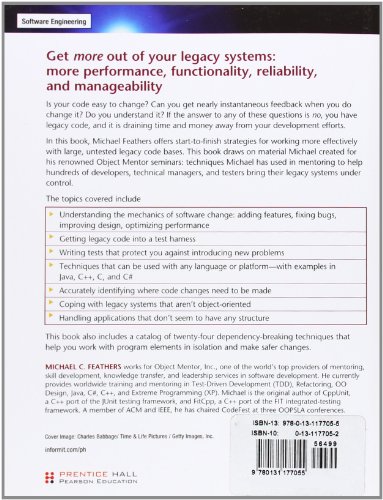
Get more out of your legacy systems: more performance, functionality, reliability, and manageability Is your code easy to change? Can you get nearly instantaneous feedback when you do change it? Do you understand it? If the answer to any of these questions is no, you have legacy code, and it is draining time and money away from your development efforts. In this book, Michael Feathers offers start-to-finish strategies for working more effectively with large, untested legacy code bases. This book draws on material Michael created for his renowned Object Mentor seminars: techniques Michael has used in mentoring to help hundreds of developers, technical managers, and testers bring their legacy systems under control. adding features, fixing bugs, improving design, optimizing performance Getting legacy code into a test harness Writing tests that protect you against introducing new problems Techniques that can be used with any language or platform--with examples in Java, C++, C, and C# Accurately identifying where code changes need to be made Coping with legacy systems that aren t object-oriented Handling applications that don t seem to have any structureThis book also includes a catalog of twenty-four dependency-breaking techniques that help you work with program elements in isolation and make safer changes. (c) Copyright Pearson Education. All rights reserved.Rang parmi les ventes Amazon: #19579 dans LivresMarque: Brand: Prentice HallPublié le: 2004-09-22Langue d'origine: AnglaisNombre d'articles: 1Dimensions: 9.10" h x 1.10" l x 7.00" L, 1.60 livres Reliure: Broché456 pagesPrésentation de l'éditeurThis book provides programmers with the ability to cost effectively handlecommon legacy code problems without having to go through the hugelyexpensive task of rewriting all existing code. It describes a series of practicalstrategies that developers can employ to bring their existing softwareapplications under control. The author provides useful guidance about how touse these strategies when refactoring or making functional changes to codebases. One of the book's key points is that it teaches developers to write teststhat can be used to make sure they are not unintentionally changing theapplication as they optimize it. Examples are provided in Java, C++, and Csharp,and the book assumes that the reader has some knowledge of UMLnotation. Strategies using UML and code in C++ and Java primarily whilelanguage independent advice will be delivered in side bars and appendices forlanguage specific users. Quatrième de couvertureGet more out of your legacy systems: more performance, functionality, reliability, and manageability Is your code easy to change? Can you get nearly instantaneous feedback when you do change it? Do you understand it? If the answer to any of these questions is no, you have legacy code, and it is draining time and money away from your development efforts.In this book, Michael Feathers offers start-to-finish strategies for working more effectively with large, untested legacy code bases. This book draws on material Michael created for his renowned Object Mentor seminars: techniques Michael has used in mentoring to help hundreds of developers, technical managers, and testers bring their legacy systems under control. The topics covered includeUnderstanding the mechanics of software change: adding features, fixing bugs, improving design, optimizing performance Getting legacy code into a test harness Writing tests that protect you against introducing new problems Techniques that can be used with any language or platform—with examples in Java, C++, C, and C# Accurately identifying where code changes need to be made Coping with legacy systems that aren't object-oriented Handling applications that don't seem to have any structureThis book also includes a catalog of twenty-four dependency-breaking techniques that help you work with program elements in isolation and make safer changes.© Copyright Pearson Education. All rights reserved.Biographie de l'auteurMICHAEL C. FEATHERS works for Object Mentor, Inc., one of the world's top providers of mentoring, skill development, knowledge transfer, and leadership services in software development. He currently provides worldwide training and mentoring in Test-Driven Development (TDD), Refactoring, OO Design, Java, C#, C++, and Extreme Programming (XP). Michael is the original author of CppUnit, a C++ port of the JUnit testing framework, and FitCpp, a C++ port of the FIT integrated-testing framework. A member of ACM and IEEE, he has chaired CodeFest at three OOPSLA conferences.© Copyright Pearson Education. All rights reserved.Vous trouverez ci-dessous quelques critiques les plus utiles sur Working Effectively with Legacy Code. Vous pouvez considérer cela avant de décider d'acheter / lire ce livre.
0 internautes sur 0 ont trouvé ce commentaire utile.Un must-havePar Edouard PaumierC'est un ouvrage essentielle pour quiconque est intéressé par les tests automatisés (voire par le TDD) mais ne trouve pas le courage d'en faire. Michael Feathers présente de nombreuses méthodes pour réussir à mettre en place des tests sur un code existant, et ce sans risque ni grand investissement.Il présente également une autre façon d'utiliser les tests: pour découvrir le comportement du code existant, tout en figeant son état avec les tests.Contrairement à ce que le titre de l'ouvrage pourrait indiquer, ce dernier s'adresse à toutes personnes qui travaille avec du code existant non testé, quelque soit l'âge de ce dernier.
Si vous avez un intérêt pour Working Effectively with Legacy Code, vous pouvez également lire un livre similaire tel que cc Refactoring: Improving the Design of Existing Code, Clean Code: A Handbook of Agile Software Craftsmanship, The Clean Coder: A Code of Conduct for Professional Programmers, The Pragmatic Programmer: From Journeyman to Master, Domain-Driven Design: Tackling Complexity in the Heart of Software, Growing Object-Oriented Software, Guided by Tests, Design Patterns: Elements of Reusable Object-Oriented Software, Test Driven Development: By Example, The Software Craftsman: Professionalism, Pragmatism, Pride, Code Complete, Second Edition